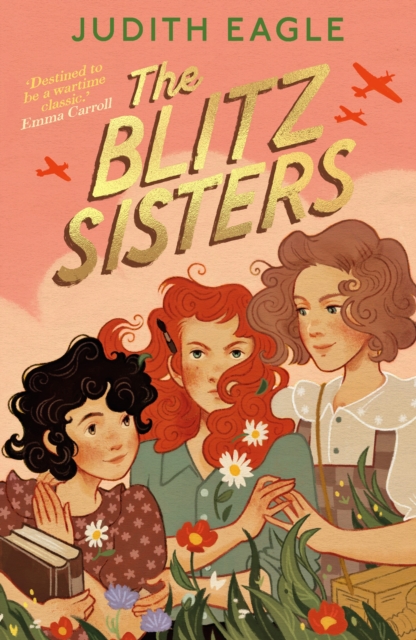
Judith Eagle’s new title The Blitz Sisters introduces readers to three sisters as they navigate life during World War II. Offering insight into life during a frequently studied period, this title is suitable for Upper Key Stage Two or Key Stage Three. Judith has very kindly written for us about how history shapes her book ideas and how she brought the story of these three girls in particular to life…

:

History is a treasure trove of inspiration
When I’m invited to talk to young readers about my books and my approach to writing, I’m often asked where I get my ideas from. My answer is always the same – history. History is a treasure trove of ideas and inspiration. Pick any period and you have a wealth of information at your fingertips – not only the everyday stuff such as how people dressed, ate, were educated and spent their leisure time, but also significant events – historical happenings – that can be woven into stories to add authenticity and a solid sense of time and place.
My latest book, The Blitz Sisters is mainly set in London, which is where I live. Happily, this gave me easy access to established archives such as Southwark archives, the Imperial War Museum archives, and the National Archives. In addition, local societies such as the Peckham Society proved to be wonderful repositories of knowledge. It was here that I learned about the South London Emergency School – one location combining several local schools – for children who hadn’t been evacuated; I also discovered that the playgroup my daughter once attended on Peckham Rye had, in a previous life, been a Prisoner of War camp where Italian prisoners kept pigs and chickens and grew their own vegetables. It wasn’t a closed camp, and the ‘prisoners’ were often seen out and about. One had been a tiger tamer before the war and had the scars to prove it. Another was an opera singer. There were quite a few musicians, and they sometimes put on concerts for the locals.
Another invaluable resource was The WW2 People’s War, an archive of World War Two memories written by the public and gathered by the BBC. The first-person accounts are highly detailed, and brilliant for showing how ordinary people coped on the home front. The archive is bursting with tales of stoicism and courage, taking the researcher to the very heart of what it felt like to be bombed out of your home, to lose loved ones, to cope with rations, play on bombsites, to be an evacuee. There is much that is poignant, and heart-breaking. But there is humour and joy too. One reminiscence describes the aftermath of an air raid and the subsequent loss of a cat – until that is, a snow-white creature slinks out of the debris, shakes himself – and voila – reveals a glimpse of orange fur. A marmalade cat covered in white plaster dust. How could I not borrow this for one of the scenes in my book?!
Trawling the internet unearthed countless gems: a painting by the artist Carel Weight, depicting a zebra escaping from London Zoo after a high explosive bomb fell on the zebra house; the call to artists to ‘brighten up’ the government run British Restaurants with murals and paintings; the Royal College of Art students who astonished the locals ‘with their wild woolly beards’ when they were evacuated to Ambleside; the brave Dead End Kids of Wapping, who formed their own Civil Defence Unit, heroically diving into burning buildings to rescue both people and belongings. All of these found their way into my book.
The more I delved into the past, the more interesting stuff I found, gradually filling four notebooks with scribbled research, and 74 pages of a word document with links to photographs, paintings and fascinating facts.
Of course, at some point the research must stop and the writing must commence. The challenge is to write a cracking story that is not encumbered with historical research but buoyed by it. My approach was to hand the reins over to my characters, sisters Lydia, Peggy and Teddy, and live the war through their eyes. In this way, the story is given space to feel fresh and new, as well as authentic. Well, that’s the hope, anyway!
~
Many thanks to Judith for writing for us about historical writing. You can read more about The Blitz Sisters using the link below or find The Blitz Sisters and other historical fiction on our Historical Fiction Secondary booklist.
The Blitz Sisters
Judith Eagle
ISBN: 9780571388707
Three sisters, two devastating bomb blasts, one life-changing war . . . Little Women for younger readers set during World War Two and beyond. ‘Judith Eagle is Noel Streatfeild for a new generation.’ Katya Balen ‘Funny, charming, poignant.’ Emma Carroll ‘Stayed with me long after I turned the final page.’ Jasbinder Bilan ‘A brilliantly written page-turner that brings history to shimmering life.’ Lauren St John War has been declared and the lives of three sisters, Lydia, Peggy and Teddy, are about to be turned upside down. As bombs rain down on London, the girls will lose their homes, their things, their loved ones . . . But they will find lost kittens, friendships with fellow rebels, the need for art, the strength and love to carry on, and a greater sense of family than ever. And with each other’s help and with the radical changes to society that war brings, the three sisters will discover the essence of who they truly are. Lydia’s story: it’s 1939 and war has been declared. The girls have been evacuated to the countryside. Lydia, the oldest and always the sensible one, is finding a way to make everyone feel safe – with her cooking! But the weight of responsibility begins to feel unbearably heavy and Lydia decides to take drastic, dangerous action . . . Peggy’s story: it’s 1943 and the girls are back in London, crammed into a house in Peckham Rye with numerous friends and relatives. Peggy, the arty one, is at school and hating it. Inspired by her new friend Arno, a refugee from Germany, Peggy is determined to go to art school, whatever the cost . . . Teddy’s story: it’s 1946 and the girls are living through the war’s aftermath. Teddy, the clever one, is excelling at school. So when a school trip to Paris is on the cards, the family are keen to find the money for Teddy to go. Little do they know that, instead of learning French, Teddy plans to try and find one of the family’s very dearest lost loved ones . . .