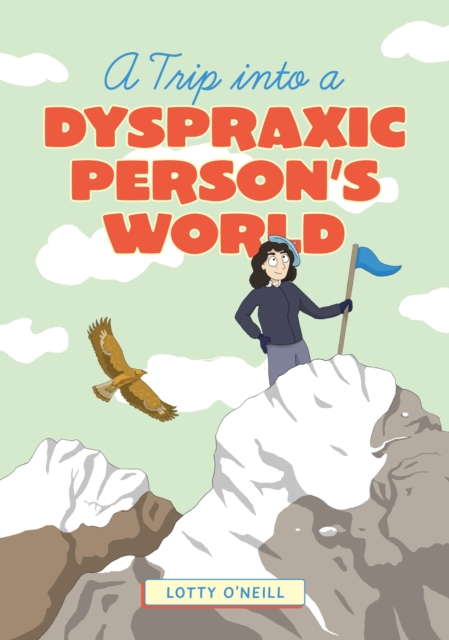
Charlotte O’Neill’s graphic novel A Trip into a Dyspraxic Person’s World is exactly what you might imagine from the title! Inside are loads of graphics and illustrations that offer a young person’s experience of having, understanding and negotiating dyspraxia. Charlotte very kindly answered some questions for us about how her own experience being dyspraxic lead to her creating her book and what she hopes readers will get from it…

:
Dyspraxia is probably not as well understood as it might be, why did you decide to create this story?
I decided to tell the story of my own experience with dyspraxia, due to the lack of knowledge within the general population about this form of Neurodiversity. Whilst ADHD and Autism have come much more into the for-front of the publics consciousness in recent years, as the neurodivergent movement has grown, dyspraxia is a condition that is still not given that much of a spotlight. This is surprising, as at least 10% of the population have dyspraxic traits and it has a high co-occurance rate with Autism. Due to the lack of knowledge, undiagnosed people may feel as if the symptoms of dyspraxia are personal faults and those around dyspraxic people may struggle to understand why they act the way they do. I wanted to change this, to make it so that dyspraxia is more understood and more known, so that dyspraxic people are empowered to advocate for themselves and those around them can advocate for them.
What sort of research/brainstorming did you do during the early stages of writing?
I was a recent graduate from my bachelors degree when I worked on the early stages of writing, and so took an academic approach to research. For me, this involves compiling a lot of sources into one big list, contacting researchers for scientific papers that were not available online, reading through the massive list and making notes of everything of use and also running an anonymous survey into what people believed the positive aspects of their dyspraxia were!


You also did the illustrations, what mediums do you use and how do you figure out the order and layout of the words and pictures?
I am an artist and animator, and my experience has mostly been in digital art (though I can use traditional mediums as well!). This entire book was illustrated digitally using Sketchbook Pro and an Intuos Wacom drawing tablet (which I lost the pen for multiple times!) As for figuring out the order and layout, it mostly depended on what ‘made sense’, what flowed the best and what made it understandable. A lot of neurodivergent people struggle with sensory processing difficulties, so a jumble of words and illustrations with no order might be a struggle for some people!
What do you hope young people reading this book take from it?
I hope young people reading this book come away with a better understanding of themselves and their peers, but also the ability to embrace those parts of themselves that do not fit in with societal norms. Dyspraxia can make your life hard, and some days are better than others (I had a pretty awful day last week where one mistake made ruined a whole day!). But it isn’t all bad and there are plenty of positives to embrace too. I also want dyspraxic young people to dream big. There are plenty of things you are told you cannot do due to dyspraxia, but I want them to know that they can achieve the things that they want to do, it just might be a longer journey.
Were there any parts that were particularly fun or particularly tricky to write and/or illustrate?
I would say the whole illustration process was very fun! I especially enjoyed adding in some natural history elements throughout the book to reflect my interest in nature. I especially enjoyed drawing the mountain scene and the expedition, as these are based on my own adventures. As for the tricky part, the parts about the bullying I experienced at school brought up some buried feelings and felt like a bit of a vulnerable thing to write about. I think it is important to push past that though, as there are many dyspraxic young people who have probably experienced the same and need to see that they are not alone.
Would you like to share an external resources or spaces that you think are useful for those who would like to know more about dyspraxia?
Dyspraxia UK is a good resource for finding out more about dyspraxia, and dyspraxia magazine is a great publication for hearing more about the perspectives of dyspraxic people!
~
Many thanks again to Charlotte for sharing her insight. You can read more about or order her book A Trip into a Dyspraxic Person’s World below.
A Trip into a Dyspraxic Person’s World
Charlotte O'Neill
ISBN: 9781839975172
Stay Dyspraxic and Fantastic! If you’re dyspraxic, you might struggle with things like sports, handwriting, remembering stuff or staying organised. But you will also have great strengths too! In this book you will meet Lotty, a young dypraxic person who can share all her knowledge about dyspraxia and give you plenty of handy advice. Filled with funny illustrations, this book explains what dyspraxia is, why it can make some things harder and how dyspraxia also makes you awesome! You can also find handy tips and simple activities to feel confident and proud in your identity. Lotty teaches you how to build routines, develop your coordination, ask for help at school, and so much more so you can turn challenges into opportunities. There are also ideas for how your friends, teachers and family can support you along the way