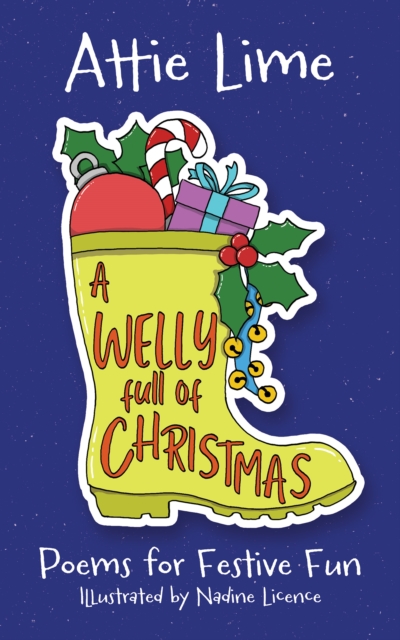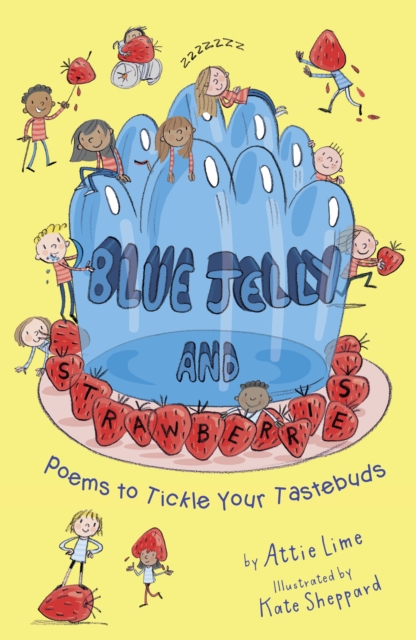
Attie Lime is poet who absolutely loves to play with words!  Her collection of poetry Blue Jelly and Strawberries has plenty of fun poems for primary children and she has new title – A Welly Full of Christmas – out in October.

She has shared some insight with us about the joy and the expanse of poetry and offered teachers, including those who might shy away from finding joy in poetry, a few places to start with their classes!

~

Poetry Play

I grew up with wordplay. My mum used to sing around the house, often changing the lyrics for something funny, or just good old nonsense. At 87 she still uses lots of the ‘family language’ created over the years. My children now adore this idea and often add a new word into the family dictionary. Words like bananoo, sockles, crumpigs (banana, socks, crumpets). I’ll be honest – I made these up, because I don’t want to share our real ones. They’re such a precious part of our family folklore, especially as my mother gets older, and the family is spread across the miles. These playful words unite us and never fail to make us smile.

Children naturally play with words; we know that toddlers often ‘invent’ new words when they can’t quite wrap their mouths around the actual word. Think ‘lello’ for yellow, or ‘gaga’ for Granny. Imaginative play is encouraged in children, and teddies or fictional worlds might be given wonderfully creative names. And then, gradually, things change; we begin to use ‘real’, ‘sensible’, ‘actual’ words for things, and school decides rights and wrongs. There is less creative play, and we’re expected to grow up. I think we’ve all got the need to play with words, regardless of age – you show me a dog or cat owner who doesn’t have at least five different variations on their pet’s name!
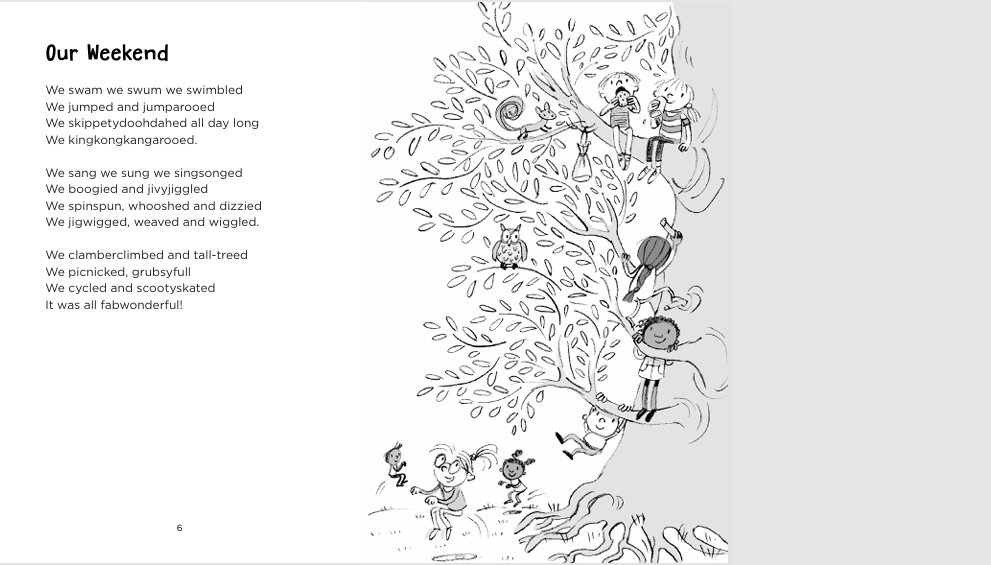
I love being a children’s poet for many reasons but being able to indulge my love for wordplay scores highly. As I say in my introduction during school visits: I have the best job in the world, as I get to play with words all day long! The opening poem in my first solo collection for children, Blue Jelly and Strawberries, is full of nonsense words. I let myself play with words to echo the topic of the poem. It is called Our Weekend.

We swam we swum we swimbled

We jumped and jumparooed

We skippetydoohdahed all day long

We kingkongkangarooed


I’m told by primary teachers that they sometimes feel unsure about teaching poetry. I do understand; I wasn’t a fan of the poetry I was taught at school and often felt that I didn’t understand it in the way I should. Those experiences stay with us. I tell schools I work with that I don’t teach poetry – the focus is on enjoyment. I like to see poetry enjoyed without feeling the need to label its parts, or to get out the Literacy Scalpel. Let children hear it, feel it, read it, act it out, choose it, experience it, just enjoy it. Poetry For Pleasure.

Poetry allows creative freedom like no other kind of writing. It is language set free; unless choosing to write to a strict form, it frees us from the usual restraints and boundaries, and levels the playing field. In poetry there are no ‘rights and wrongs’, a lot can be said with a little, and play is always a positive. Poetry comes naturally to children, and is beneficial in so many ways, imaginative expression being just one of them. Engaging with poetry can help to increase reading fluency, confidence in children’s own writing, and speaking in front of others. It has benefits for self-expression, cultural and social awareness, and mental health. It widens vocabulary.

My advice: give them some prompts, props, and encouragement, and let them PLAY.

Some ideas to spark poetry

  • Choose a simple poem from a children’s collection or anthology (repeating lines work well). Read it together (listen/watch if a recording by the poet is available), talk about it, then let the children write their own version – keep the “Try to…” and “If you can…” and “Remember to…” to an absolute minimum. Let them forget about spellings and neat handwriting for half an hour and just write.
  • Play word games – talking games, like finding as many rhyming words as possible, word association, making up nonsense words. Then give them some paper and pens.
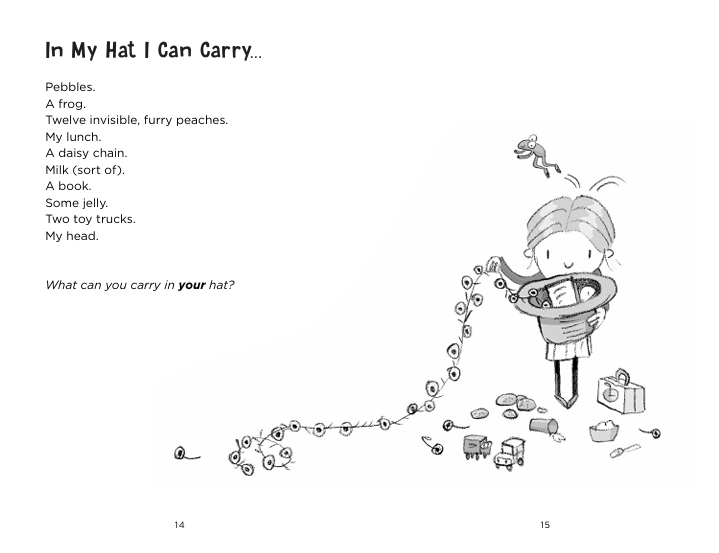
  • Imagination challenges, like thinking up the craziest sandwich filling they can imagine – this kind of game translates brilliantly into list poems:

In my sandwich, I put

A squashed banana covered in cat hair

A slice of concrete

A smelly sock

A squeeze of toothpaste

The bits from the raspberry jam

Some pencil shavings

And

My homework

  • Hide something (or nothing!) in a box or your hand and let the children wonder and imagine what it might be. Lots of discussion, and all ideas allowed (e.g.no “It can’t be, it wouldn’t fit”). Children might want to write question poems (Is it a tiny snake, curled into a spiral? Is it a shiny new conker? Is it a wish, held tight?), list poems, or poems imagining one thing and describing it in detail.
  • Have fun!

~

Many thanks to Attie for sharing her poetry joy!  You can find her two books below and more poetry in our primary poetry category here.

Tanglewood 3 scaled

From the Drawing Board: Gillian McClure

Sneak Peek feature Beautiful e1765979343946

Library Sneak Peek: The Really Beautiful Thing by Frances Tosdevin & Ali Pye

Spotlight How We Used to Live feature

Introducing: How We Used to Live

Poetry by Heart Globe

Our Experience: Poetry by Heart