White banner with blue open book on the left and the text

:

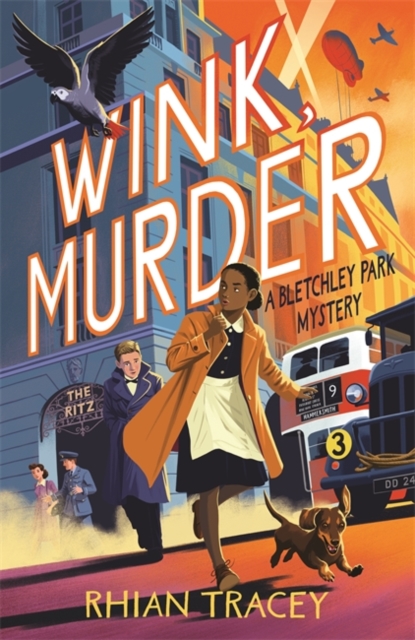
Rhian Tracey’s third historical fiction Wink Murder throws readers back into the murder, mystery and subterfuge of The Bletchley Park Mystery series.

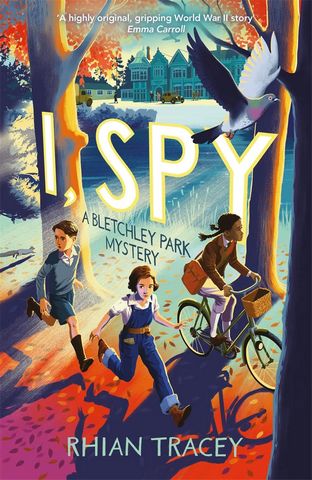
The series, which is great for Key Stage 2 or Key Stage 3, is set during World War Two Britain.  The three novels, I Spy, Hide and Seek and now Wink Murder transport readers to the very real Bletchley Park at a fascinating yet dangerous time.  The adventures of the series are fictitious but derive from very real experiences of the everyday people who lived through the Second World War.

Rhian has very kindly shared the origins of her series, the real life inspiration she drew upon and the surprising way fact can end up stranger than fiction…

~

Brought up in Wales, I was taken to castles and historical houses every weekend (or at least that’s what it felt like), breathing in the air of dragons, walking in the footsteps of the Tudors over drawbridges, climbing up the stone spiral staircases to the battlements, and poking my head out of turrets; it’s no wonder that I became obsessed with history. Our little bungalow, in the middle of the Brecon Beacons, was filled with music, stories, myths, and legends, and I drank it all in. We are a family who love telling a good story and sharing an anecdote, and to me, there’s nothing more natural than hearing, or, let’s be honest, eavesdropping on a fragment of a conversation and falling down a rabbit hole of what-ifs. So, when I found out that my great-aunt, Audrey, had accidentally revealed over a pub lunch that she had been a codebreaker in Bletchley Park my imagination went into overdrive. This was the inspiration for the set of stories that would become my Bletchley Park Mysteries. From this starting point, I did lots of research and drew on stories from many different places.

I instantly signed up as a parent helper on a trip to Bletchley Park, with my daughter and her year six class, filling a notebook with facts as I tried to keep eight children in check as well as soak in the unique atmosphere of the site. And on the bus on the way back to school, after being questioned by year six and given their top tips for writing a great story – a child who doesn’t follow the rules, an animal who does a job, and a secret to be solved –  I sketched out the opening scene to I, Spy.

I wisely spent a lot of my time as a child climbing trees, finding the ones with the lowest branches, which would give me a leg up, and those that offered the highest and best views, so it felt quite natural to start I, Spy with a girl climbing a tree, taking in her surroundings, and spying on the adults around her, just like I did. Living in amongst rivers and canals, I enjoyed many hours swimming and canoeing and rowing little boats and was delighted to spot the boating lake at Bletchley and knew that the lake and its island would be central to my story.

After that first visit, I went back many times; I would roam Bletchley Park for hours on end, making notes, listening to the oral histories on the Bletchley Park podcast, and using the multimedia guide and audio descriptions of various exhibitions, but as soon as I set foot in the pigeon room, I knew I had found the heart of my story. I’d heard of carrier pigeons and watched the animated comedy film, Valiant, many times with my children, but really, I had only scratched the surface of the extraordinary service these birds provided in warfare. My obsession with carrier pigeons began just as we went into lockdown because of Covid-19. I spent my afternoons happily reading books about pigeons and watching videos on YouTube, much to the concern of my children.

I wrote most of I, Spy during lockdown and found it quite easy to imagine what it would have been like locked down at Bletchley Park during the war, living in unprecedented times, with no idea when things would go back to normal, if indeed they ever could.

~

After I finished writing I, Spy, I wanted to explore my characters worlds further and remembered a box I’d seen in Upton House, on a trip there with my children. It had caught my eye because it was marked 1940 NATIONAL GALLERY STAFF INVESTIGATING BLAENAU FFESTINIOG SLATE QUARRY AS A STORE. I’d taken a photo of it, not knowing that 8 years later it would be the spark for Hide and Seek, the second book in the Bletchley Park Mystery series.

Hide and Seek follows Ned from Bletchley to Manod, in North Wales, where the National Gallery successfully hid over 2000 paintings from the enemy who were desperately trying to get their hands on our national treasures. I visited the National Gallery and threw myself into research, where I discovered the Picture of the Month scheme, which started in the war to appease Londoners whose museums and galleries had been emptied; one painting was sent from the quarry in Manod, back to London, to be displayed for the month. And so, I had my plot, aided by a brilliant guide dog, knitting spies, twists, and turns as sharp as Manod mountain path, and another trio of friends who would do anything for each other.

~

The idea for Wink, Murder, the third book in the Bletchley Park Mystery series, came about thanks to a hamper from Fortnum and Mason.

One Christmas, in an attempt to buy my great-aunt Audrey something she didn’t already have, my aunty Pat and my cousin Kate bought her a gorgeous hamper full of lovely food and drink. When Audrey opened it, she casually remarked, “Oh I used to love going into Fortnum’s on my lunch break!” As far as the family knew, Audrey had never lived in London and had certainly never been to somewhere as posh as Fortnum’s before! After being assured, once again, that the Official Secrets Act was now declassified, and she could legally talk about her war work on Japanese Naval codes without fear of being incarcerated, or worse, Audrey cautiously revealed that she had worked for SIS (Secret Intelligence Service) on Berkeley Street, in offices above a women’s boutique, Madame Riché, Couturière des Dames, which served as a ‘front’. If you’ve seen the film Kingsman and the iconic scene in the tailor shop, you’ll get the picture.

Much like the children in my novels, I pieced together the tiny clues dropped, which led me to an attic room above a gas showroom in Bedford where, during the war, a handful of young people had been given a crash course in Japanese before being dispatched to places like Bletchley Park to teach others. And Audrey was one of the chosen few, and it was this course that led to her being recruited by Alastair Denniston, who took over the diplomatic section in London, after he stepped down as Head of Bletchley Park. I was interested to know how and why Audrey used her knowledge of Japanese and learnt about the Secret Listeners at Trent Park, and the work they did during the war, including the ‘wining and dining’ of captured high-ranking Axis officers at the Ritz and Fortnum and Mason! The pieces of the puzzle fell into place, and Wink, Murder, unfurled in my mind, following Mary from Bletchley, to Bedford, back to Bletchley, and on to the Ritz. It turns out the truth is really stranger than fiction, and I love nothing more than blending the two in my writing.


This series is great for any classrooms looking for historical fiction to do with the Second World War or indeed for those students who like mystery and history when seeking out reading for pleasure titles.  The Bletchley Park Mysteries offer readers a taste of adventure, peril and discovery during a period of history that, while frequently discussed and learned about, is a from long before those readers were born and a far cry from what they know.

Many thanks again to Rhian for sharing her journey bringing these stories to life.

Tanglewood 3 scaled

From the Drawing Board: Gillian McClure

Spotlight How We Used to Live feature

Introducing: How We Used to Live

Poetry by Heart Globe

Our Experience: Poetry by Heart

Author Event Josh Lacey 1 e1764842412373

Author Events: Josh Lacey