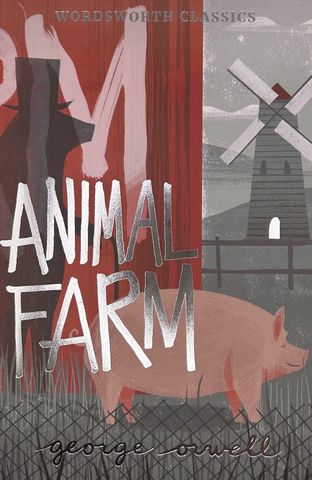
By 1943, the case for Animal Farm had become urgent. With the Soviet Union now Britain’s ally against Nazi Germany, criticism of Stalin’s brutal regime was censored or actively discouraged, and plenty of left-wing intellectuals still celebrated the Soviet project, insisting that the horrors of its show trials, summary executions and secret police were exaggerated, or else necessary. Orwell, by contrast, had always considered Stalin a “disgusting murderer”, and wanted a powerful, memorable way to say so. A political essay would never reach a wide enough audience; a conventional novel would take too long to write. His solution was to fuse the moral clarity of the traditional beast fable with the satirical method of Gulliver’s Travels: a group of farmyard animals, led by the pigs, overthrow their human masters in a revolution built on high ideals — the farm run for the animals’ own benefit, with no more slaughter, food enough for all, and comfort in old age. But once Napoleon the pig seizes control, those principles are corrupted one by one, and a new tyranny emerges, worse than the one it replaced. Orwell wrote the book in the middle of the Second World War, though no publisher would touch it until August 1945, once the fighting was over. This little book quickly became a defining text of the emerging ‘cold war’ — a phrase Orwell himself coined — and was itself fought over, subjected to repeated attempts to subvert or reshape its meaning. Today, Animal Farm endures as a powerful fable about tyranny and corruption that speaks to every age. This edition also includes the following essays: Shooting an Elephant; Charles Dickens; Inside the Whale; The Frontiers of Art and Propaganda; Literature and Totalitarianism; Fascism and Democracy; Patriots and Revolutionaries; Catastrophic Gradualism; Some Thoughts on the Common Toad; Why I Write; Writers and Leviathan
ISBN 13: 9781840228038
Author: George Orwell