How can Oxford Revise help students to revise more effectively?
If you’re anything like me, one of the questions you’ll be asked the most by students is how they should revise. Most students and parents don’t really know how to do it. So how can we help?
Cognitive scientists have found that when students spend time re-reading their notes, highlighting them or even summarising them, they tend to remember very little afterwards.
When writing the new Oxford Revise series, we took a three-step approach: knowledge, retrieval, and practice. Here I’ll go into detail about what each of these steps means, but it is important to remember that all three work together to make sure revision is effective.
Knowledge
First is knowledge. How well does the student understand the material that they then need to learn? To help with this, we have made Knowledge Organisers that are really clear, easy to understand and concise – we’ve cut out anything that students don’t need to know for their exams. We’ve then taken all of that stuff and organised it, making sure that it all fits together and flows from one idea to the next. This means that when students are studying the organiser, they start to learn the ‘bigger picture’.
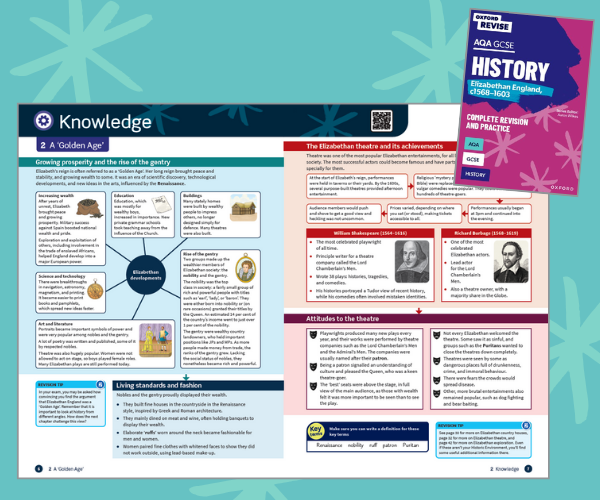
The knowledge stage must happen before students start to revise. Students should use the Knowledge Organiser first to make sure that they understand everything and how it all fits together, and then they can start trying to make sure they can remember it by moving on to the retrieval section.
Retrieval
Cognitive scientists have found that they best way to remember things is by ‘retrieving’ them for yourself. ‘Retrieving’ is like ‘fetching’ – it’s when you have to go deep into your memory to try and fetch an idea
For Oxford Revise, we’ve written really short questions and answers after each Knowledge Organiser. If a student takes a piece of paper and covers up the answers, and then tries to write down the correct answers from memory, the ideas should stick in their head much better over a long time, and they will be more likely to remember them.
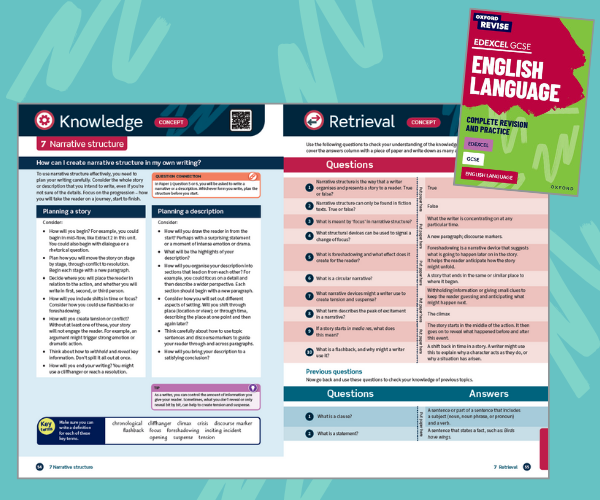
Students can also do a retrieval practice with the Knowledge Organiser. After reading a box, they can cover it up with a piece of paper and then retrieve everything they can remember about that box by writing it down on the piece of paper.
It’s also a good idea to spread retrieval practice over time, so when you come Chapter 6 in a book, for example, you’ll find that we’ve put questions from Chapters 1, 2, 3, 4 and 5 in there too. This is a great way to make sure that students are strengthening their memories of the whole course, not just the bit they’re currently studying.
Rather than just doing the retrieval questions once, encourage students to come back the next day and try them again with a blank piece of paper. And remember, it’s important to actually write down the answers as otherwise our brains can trick us into thinking we know them when we don’t really.
Practice
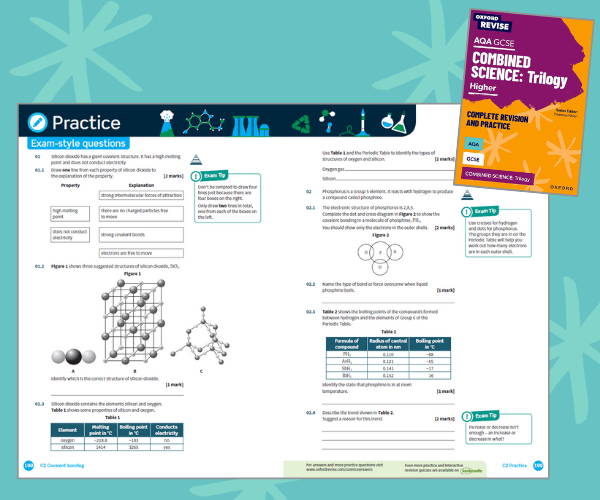
Once your students know those answers really well, they can move on to the final stage: practice. Here, we’ve written an absolute ton of exam-style questions for students to practice with, so they are a great way to start preparing and for students to perfect their responses and exam technique.
So, what’s the best way to revise?
Knowledge: Use the Knowledge Organisers to understand and know the material
Retrieval: Use retrieval questions, covering the answers with paper. With repeated practice over a long time, students will be able to recall or ‘fetch’ the answers more quickly.
Practice: Lots and lots of practice.
It may feel at times like it’s going really badly, but it works – the science says so!
There are Oxford Revise guides for Computing Science | English Language | English Literature | Geography | History | MFL | Psychology | RS | Sciences
You can find out more about the Oxford Revise series by clicking any of the images below to go direct to each book’s description.
A version of this blog was originally posted on educationblog.oup.com in February 2020.

Oxford Revise: Edexcel A Level Maths
Original price was: £21.99.£16.49Current price is: £16.49.
Oxford Revise: Edexcel GCSE History: Migrants in Britain, c800-present
Original price was: £5.99.£4.49Current price is: £4.49.

Oxford Revise: Edexcel A Level Geography
Original price was: £21.99.£16.49Current price is: £16.49.

Oxford Revise: AQA A Level Psychology
Original price was: £21.99.£16.49Current price is: £16.49.

Oxford Revise: AQA GCSE Chemistry Revision
Original price was: £7.99.£5.99Current price is: £5.99.

Oxford Revise: AQA GCSE Physics Complete Revision and Practice
Original price was: £7.99.£5.99Current price is: £5.99.
Oxford Revise: AQA GCSE Biology Complete Revision and Practice
Original price was: £7.99.£5.99Current price is: £5.99.

Oxford Revise: OCR GCSE Computer Science Complete Revision and Practice
Original price was: £10.99.£8.24Current price is: £8.24.

Oxford Revise: AQA GCSE English Language Complete Revision and Practice
Original price was: £10.99.£8.24Current price is: £8.24.