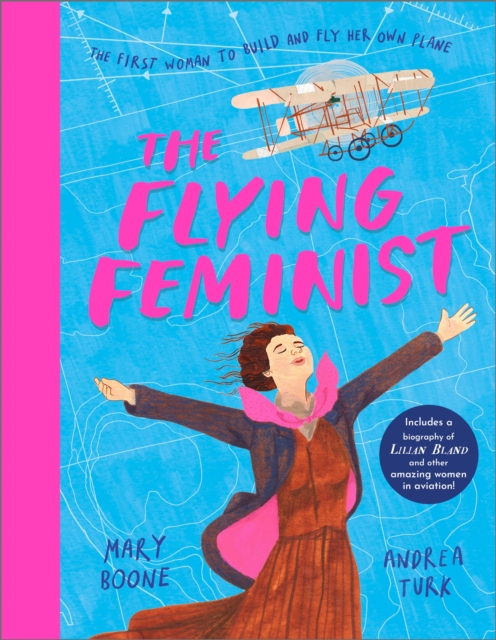
I’ve long been fascinated by early women aviators. Amelia Earhart, of course, but also Bessie Coleman, Turi Wideroe, and other trailblazers who refused to stay grounded when the world told them to. Again and again, I found myself asking the same questions: Who got remembered and who didn’t? Whose stories were left out of the history books and why? That curiosity is what led me to Lilian Bland – and to writing The Flying Feminist.
Lilian was flying before aviation had rules or role models. Born in 1878, she grew up in a world with rigid expectations for women, yet she seemed inherently unable to accept limits simply because someone else set them. She hunted, rode horses astride instead of side-saddle (Oh, my!), travelled widely, and absorbed ridicule with something close to delight. She used criticism as fuel. That fierce independence was what first made me lean in.
Lilian was living a life driven by curiosity long before she ever dreamed of flying a plane. Her interest in birds led her to become a pioneering photographer. She took what are believed to be the first colour photographs of live birds. She learned by doing, failing, and trying again. So, when she saw an image of Louis Blériot’s monoplane in 1909, her response wasn’t simply awe – it was intention. She decided she would build her own aircraft. It really didn’t matter that she had no instructions, no precedents, and no real support. She believed she could, and she did.
What Lilian achieved in 1910 still feels astonishing.
Just years after the Wright brothers’ first flight, she used her powers of observation and problem solving to design, build, and fly an aeroplane she named the Mayfly. Following her early experiments, Lilian told reporters: “I could hardly believe it. After each flight I ran back to see where the wheel tracks left the grass, to convince myself that I really had been airborne.” Those words capture the wonder of discovery and the disbelief that comes with doing something you’ve been told is impossible. If I hadn’t already felt a connection to this remarkable woman, that quote sealed the deal.
Why does Lilian’s story matter in 2026?
Because curiosity, courage, and creativity are more essential than ever, and because kids need to see that those traits don’t belong to one gender, one country, or one famous name. For young readers especially, Lilian offers something vital: proof that you don’t need permission, perfection, or recognition to attempt something bold.
The Flying Feminist isn’t just about a forgotten aviator. It’s about claiming space, trusting your ideas, and taking flight, even if the world isn’t ready to believe you can.