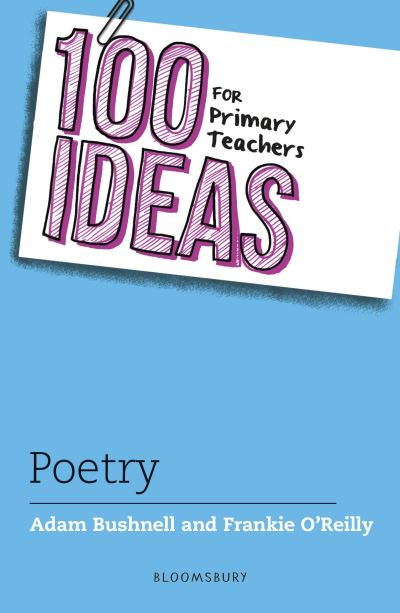
Whether the idea of teaching poetry has you at a loss or you’re simply looking to change your lesson plans up a bit, Bloomsbury’s new title 100 Ideas for Primary Teachers: Poetry by Adam Bushnell and Frankie O’Reilly could be a valuable addition to your CPD collection.  Their new title book includes quick and easy ideas for poetry lessons, including how to create a poetry-friendly classroom, interpreting poetry, writing structured poems, performance poetry and many more. The ideas are cross-curricular ideas meaning poetry is not limited to English lessons.

Adam and Frankie very kindly answered some questions for us about their journeys into poetry, why they love it and how children and teachers who are hesitant about poetry might proceed…

~

Do you have a particular place or time you enjoy composing poetry?

I love to write and read poetry in quiet moments such as early mornings or late evenings. I also have a notepad when I’m outside in nature as I see this as great inspiration.


Can you remember poetry at school? Did it help or hinder your love of poetry?

At school, poetry was sometimes treated like a difficult puzzle that needed to be solved rather than something to feel or enjoy. Over analysing poems for hidden meanings can sometimes take the magic out of them. It’s only relatively recently that I discovered a real love for poetry. Especially when teaching it.

What’s a poem you love that showcases emotion?

One powerful example is “Still I Rise” by Maya Angelou. It captures resilience, strength and pride in a way that feels both personal and universal.

But, on a more silly note; I adore Dave Ward’s ‘The Cake That Makes You Scream’. It’s the perfect performance poem and can be used in so many different ways.


What’s the biggest misconception about poetry?

That poetry has to be serious, clever or complicated. In reality, poetry can be funny, messy, loud, short, silly, emotional and playful. It doesn’t need to rhyme. It doesn’t need rules. It just needs a voice.


Why do you love poetry?

Before I became a full time, published author I took a creative writing course and my tutor recommended I write poetry. It wasn’t something I’d written a lot of before then. I love it because poetry says a lot with very little. If you can talk, imagine or feel then you can write poetry.

Do you have a particular place or time you enjoy composing poetry?

Working full-time in a school, it’s usually during the school holidays that I finally get the headspace to write! That said, I often feel most inspired when I’m away from home or travelling — being in a different place helps me relax, notice more, and let ideas settle. I also love teaching poetry to primary children; their imaginations are extraordinary and they constantly remind me how playful and powerful language can be.


Can you remember poetry at school?

Yes — very clearly. I remember studying The Rape of the Lock by Alexander Pope, alongside poets such as Seamus Heaney, Carol Ann Duffy and Simon Armitage. I was fortunate to have a teacher who encouraged rich discussion and genuine curiosity rather than looking for a single “right answer”.


Did it help or hinder your love of poetry?

It absolutely helped. Those lessons showed me that poetry is something to explore, question and feel.

What’s a poem you love that really showcases how much emotion poetry can demonstrate?

Adam has stolen my thoughts exactly — Still I Rise is extraordinary for the emotion it evokes but I Miss You by A. F. Harrold gets me every time too! I particularly love punk poetry and I’m a big fan of John Cooper Clarke, whose work proves that poetry can be sharp, funny, rebellious and deeply moving all at once.


What’s the biggest misconception about poetry?

That it’s “high-brow”, always serious, or that only certain people “get it”. Poetry is for everyone — it can be playful, silly, dark, loud, tender or absurd.


Why do you love it?

It’s free therapy! Poetry helps clarify thoughts as much as it expresses them — it allows you to make sense of feelings that you might not have the exact language for.


Poetry is often more enjoyable than children expect. What would you say to those unsure if poetry is for them?

I don’t know a primary-aged child who doesn’t love being read a good story, so narrative poetry is always a brilliant way in. Spooky poems are another favourite — something like The Listeners by Walter de la Mare instantly hooks attention. After all, who doesn’t love a good ghost story?


What would you suggest to teachers who feel hesitant about teaching poetry?

Poetry can be incredibly liberating to teach — it’s like breaking all the rules! For reluctant writers especially, poetry offers freedom and a chance to shine. Let children be silly, creative, and performative. Giving children’s writing a real purpose and a real audience — whether it be a school newsletter, an exhibition, a competition – is so important. When poetry feels meaningful, confidence and enjoyment follows.


What is the potential of poetry?

To paraphrase Albus Dumbledore: words are our most inexhaustible source of magic — capable of inflicting injury and of remedying it. Poetry harnesses that magic in its purest form. I love the idea of prescription poetry – and we look at that idea further in the book.

~

Many thanks to Adam and Frankie for sharing their poetry insight.  Their book for primary teachers 100 Ideas for Primary Teachers: Poetry publishes in April and might be just what you need to keep poetry flowing long past World Poetry Day!  You can read more about their book and pre-order it using the link below.

100 Ideas for Primary Teachers: Poetry

Adam Bushnell | Frankie O'Reilly ISBN: 9781801997874

No matter what you teach, there is a 100 Ideas title for you!

The 100 Ideas series offers teachers practical, easy-to-implement strategies and activities for the classroom. Each author is an expert in their field and is passionate about sharing best practice with their peers. A year-round campaign to celebrate the 100th book in our series is launching in July!

Each title includes at least ten additional extra-creative Bonus Ideas that won’t fail to inspire and engage all learners.


Adam Bushnell and Frankie O’Reilly present 100 poetry activities for the primary classroom that are quick, engaging and effective.

Poetry’s rhythmic and repetitive nature helps children develop phonemic awareness, vocabulary and reading fluency. This must-have book provides pages of quick and easy ideas for poetry lessons, including how to create a poetry-friendly classroom, interpreting poetry, writing structured poems, performance poetry and many more. Including cross-curricular ideas so that poetry is not limited to English lessons, this book will help you inspire your class to enjoy poetry through art, drama, history, dance and music.

Written by experts in their field, 100 Ideas books offer practical ideas for busy teachers. They include step-by-step instructions, teaching tips, taking it further ideas and online resources. 

More Details Add to basket
9781801997874
QandA Janeen

Branford Boase Shortlist Q&A: Evie & Maryam’s Family Tree by Janeen Hayat

Read A Book

Booklists for Schools: Refugee Awareness Week

Book Awards Carnegie Rob Farrell scaled

School Book Awards: Carnegie Shortlist Q&A with Rob Harrell

This Boy I Hardly Know

Writer’s Block: Lisa Heathfield