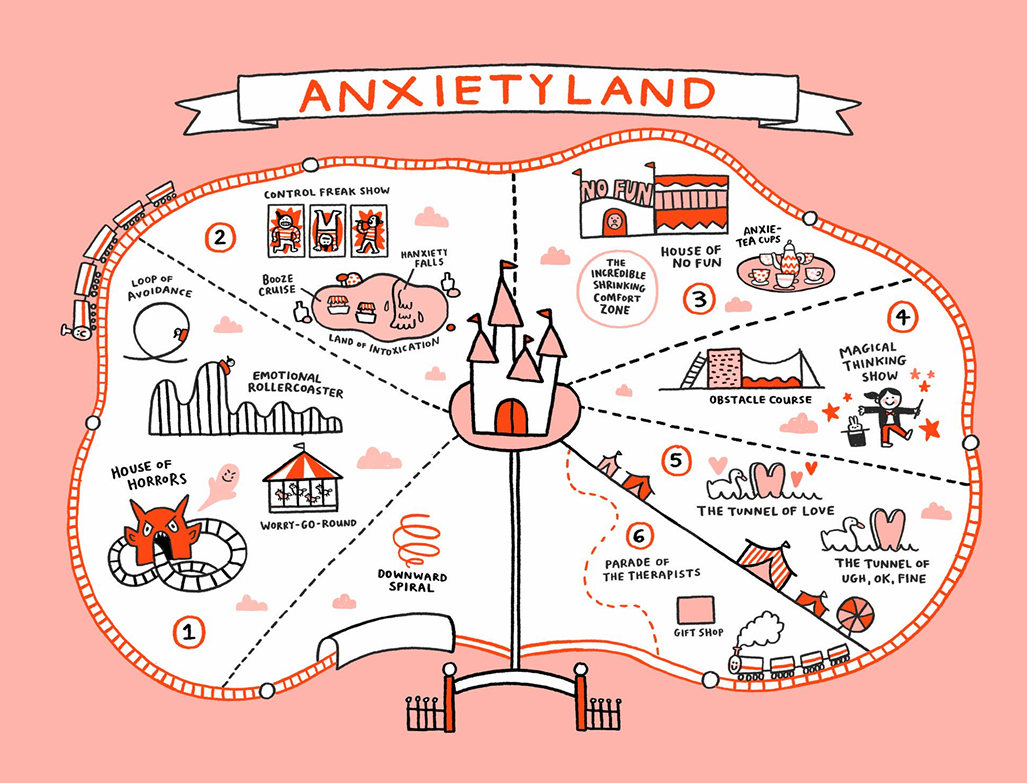
The contents page speaks directly to anyone who has had even a passing visit to Anxietyland! How long have you been thinking about creating this graphic novel and how was the process of bringing it together?
I’ve been thinking about creating Anxietyland for many years. Even before I went into hospital for severe anxiety disorder, I knew that I wanted to create a graphic novel about my experiences with anxiety and panic, but after my hospitalization I felt like I gained a lot of insight into the disorder and myself that enabled me to write a more thorough and interesting book. I started working more seriously on the book around 2021 and went through many, many drafts and iterations. I always had the central concept of “Anxietyland” as a place in mind but it took me a little while to get my head around the structure and narrative. I’m used to creating short form, humour comics, so creating something this lengthy took some getting used to.

Were the contrast colours depicting the two timelines planned from the start, how did you decide on telling each part?
I usually use red and black for my illustrations. It’s become a recognisable part of my style over the years and so I always intended for the book to be coloured this way. However, as I worked on it, I realised that there was a need to differentiate between the timelines. I considered a few different ways of doing this but ultimately decided on the contrasting colours because so much of my memory of my time in the hospital is infused with this blue/green hue – the walls and corridors of the entire hospital were painted this colour. It’s often called “hospital green” and is supposed to be calming for patients.
As serious as anxiety is there is loads of humour in this too – I laughed aloud at the airport queue anxiety fuelled questions about drugs, so relatable – were you always planning humour, why/why not?
Yes. I’ve always used humour in my artwork, even – and especially – when it’s about difficult topics. It helps me to gain a sense of perspective, to step outside of the illness rather than letting it control me. It is also a great vehicle for sharing information in a way that’s not too didactic or heavy-handed. Humour is a language spoken by the whole world! I also think that using humour also helps to destigmatise mental illness – it’s often seen as this huge, scary “other” thing and it’s really just another, holistic part of health, just like any physical condition.
The Wheel of Unsolicited Advice is so spot on, if you’re comfortable sharing who’s the most random person that’s given you ‘advice’ or the most random piece of ‘advice’ you’ve had?
A lot of random people have given me advice, which I suppose comes with the territory of making and sharing art about mental health online. Friends of friends, strangers at art shows, relatives I haven’t spoken to in years … I’ve been gifted “advice” that ranges from somewhat useful to completely ridiculous. Someone I barely knew told me that I should get pregnant! According to them, having a baby “cured” their anxiety. I’m always wary of anyone who claims to have “cured” their mental illness but this one was paticularly tone deaf.
What would you love someone reading this to take from your book whether they have experienced sustained anxiety/depression or perhaps if they haven’t but know someone who has?
When you’re in the depths of it, or watching somebody you know go through it, anxiety and depression can seem insurmountable. But I hope that my book provides a little bit of hope – that it’s possible to survive, even after falling to deep, rock bottom. You are not alone.
Not really a question, but wow the clowns! I actually cannot even imagine. This graphic novel is magnificent and I can’t wait to tell schools about it!
Thank you so much!