White banner with blue open book on the left and the text

:

An Introduction to Critical Literacy Skills for Primary School Readers

In a world full of information, some more reliable than other, Susan Martineau wanted to create a book to help young readers decipher what’s in front of them.

She has kindly shared for us how her recently updated title How to Question Everything came about, what’s inside and why it’s so important…

The words that follow are entirely my own and not generated by AI.

But how do you know if this is true? There’s an information jungle out there and it’s getting increasingly difficult to cut a clear path of truth through the undergrowth. A critical literacy toolkit will help you and the young readers in your life.

How to Question Everything is the new and updated version of my earlier book, Question Everything. There has been an explosion of AI-generated content and this raises very important questions about tracking down the facts amongst possible mis- or disinformation or just plain old, churned-up waffle. This new version includes essential advice and guidance about AI-generated information.

As a children’s information book author, I am obsessed with finding accurate, unbiased facts from reliable sources and I want to make sure that young readers have the skills to do the same. The original book came about after a conversation with my publisher about a fact-finding toolkit for young readers based on my experience of researching and writing other non-fiction books. I’d just finished the second title in my Real-life series. Real-life Mysteries and Real-life Disasters tell the stories of strange happenings and disasters, along with a case file for each one which outlines the evidence and suggested explanations surrounding each incident. I wrote the case files in the style of detective investigations to encourage young readers to consider the stories objectively and to think for themselves about what might have happened. I presented eyewitness statements and other ‘clues’, along with possible theories for each case. The massive amount of research I did for these books meant that I knew just how difficult it can be to drill down and find the facts!

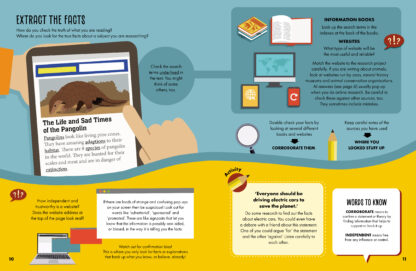
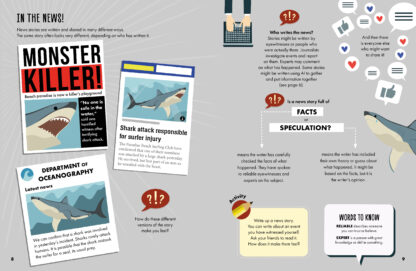
How to Question Everything brings together all the tools I used to find accurate and reliable information on-line, in books, documentary films, and any news outlets you can think of! It also includes loads of examples of the ways we are bombarded with information, advice and confusing numbers across a wide variety of media and platforms. I tried to make the book fun as well as informative. Writing hyperbolic headlines to show how words can manipulate us, for example, seemed like a great way to entertain but make a valid point.

I thought about all the questions you need to ask to find reliable information, whatever the source. Ask WHO is writing this information or news. WHY are they writing it? Are they trying to make you feel or act in a certain way? WHEN was it written? Is it out-of-date or recent information? These questions are even more important when we know that so much of what we are seeing or hearing may be created using AI.

It is vital that children learn to think for themselves. A large part of this means taking a critical, objective look at whatever they are reading or seeing. It means corroborating any information across other sources and understanding the difference between primary and secondary sources. There is a need for extra-vigilant research and thought as they navigate below the surface of the AI layer of icing that comes to the top of any search. It’s not all bad, of course, they just need to do more in-depth verification and investigate the sources used. This is not about scare-mongering. It’s about questioning in an intelligent and methodical way.

Having critical literacy skills to find a way through the information jungle will help young readers be confident, calm and thorough fact-finders. And I hope they will question anything I’ve written, too!

~

Many thanks to Susan for sharing this insight into her new book How to Question Everything.  If you are looking for critical thinking resources you can find out more about this book using the link below.  You’ll also find it included in our National Year of Reading Dip In & Out Reference page.


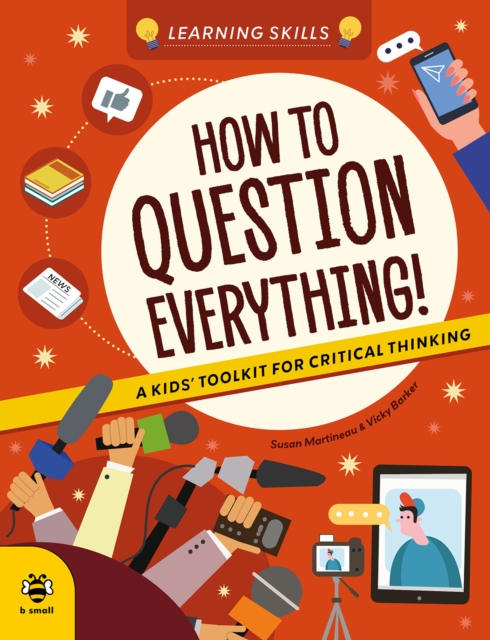
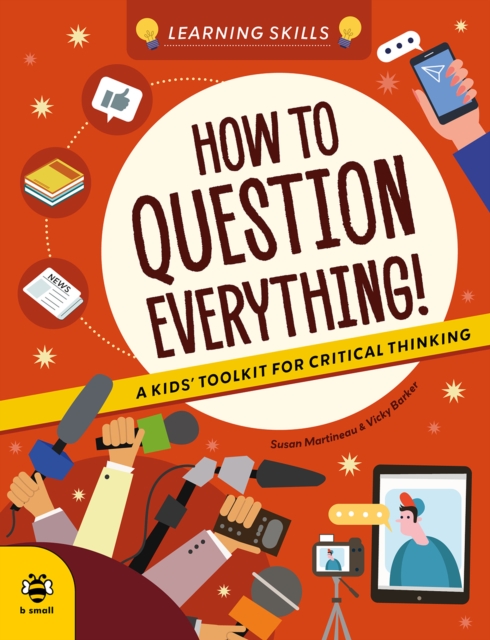
How to Question Everything: A Kids’ Toolkit for Critical Thinking

Vicky Barker | Susan Martineau ISBN: 9781916851962

Take the anxiety out of ‘breaking news’! It’s a jungle out there – an information jungle to be exact. The critical literacy skills in this book will help you cut through the noise, find the facts and grapple with the stats. It’s not just about spotting fake news either, there are sources to consider and clever words to understand. Learn about the world in a calm and safe way! Revised edition updated to include information about AI (Artificial Intelligence).

More Details Add to basket
9781916851962
QandA Janeen

Branford Boase Shortlist Q&A: Evie & Maryam’s Family Tree by Janeen Hayat

Read A Book

Booklists for Schools: Refugee Awareness Week

Book Awards Carnegie Rob Farrell scaled

School Book Awards: Carnegie Shortlist Q&A with Rob Harrell

This Boy I Hardly Know

Writer’s Block: Lisa Heathfield