Drawing Board Illustrator Banner

:

Make Room in your Library for a Novel that’s part Graphic Novel!

Meet Monsieur Mustard, a mouse reminiscent of Hercule Poirot, who is ready to both solve a dastardly crime and offer a bridge between graphic novels and chapter fiction.

Author and illustrator Charley Rabbit answered some of our questions about the Monsieur’s first foray into detecting in The Disappearance of Fabio Fangtooth

~

Monsieur Mustard 1

What inspired Monsieur Mustard? Was he always going to be a detective?

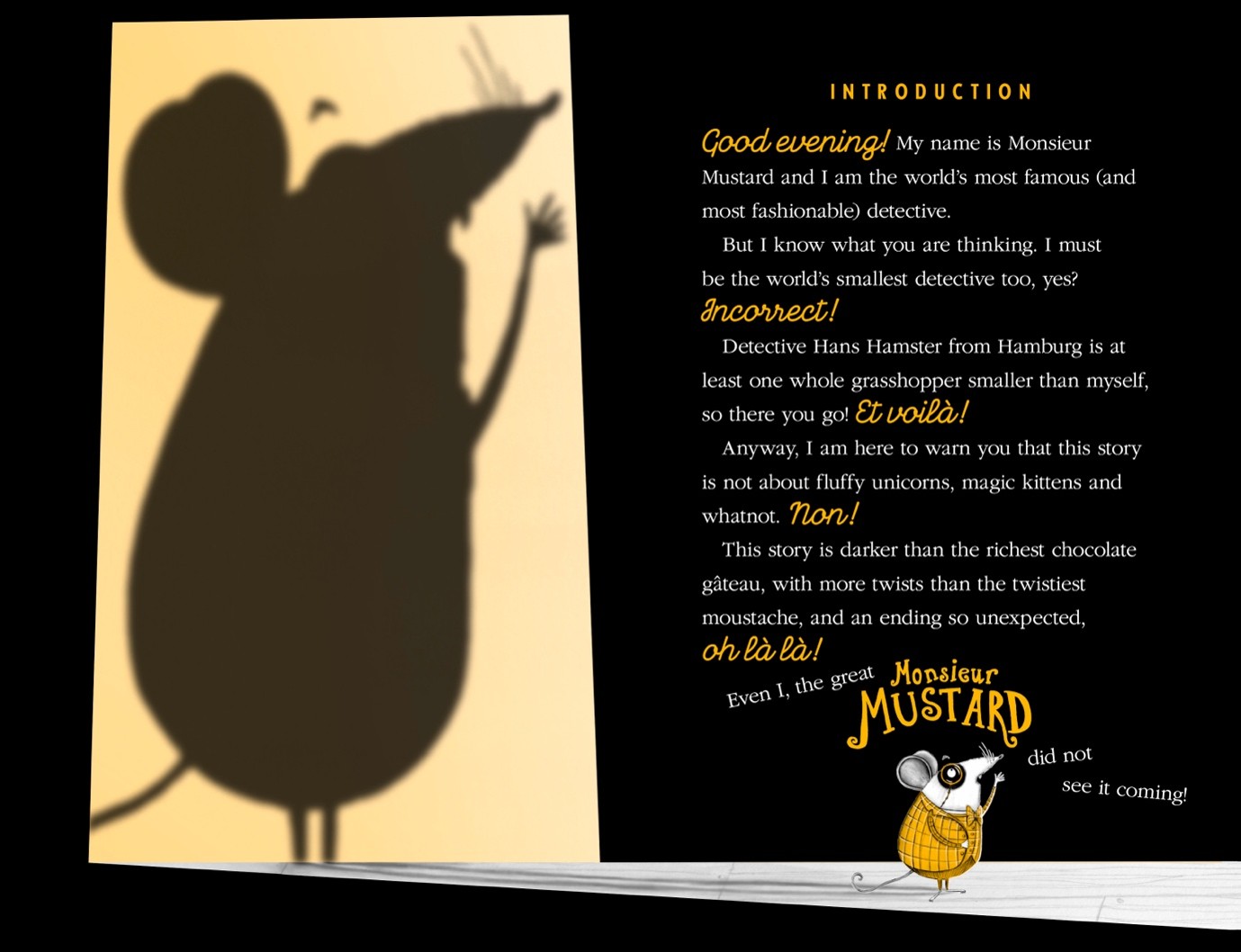
Inspired by children’s books like Rabbit & Bear and Mr Penguin, plus a love of old-school detective stories and true crime podcasts, I created Monsieur Mustard with a dash of Hercule Poirot – and a smidge of Paddington Bear.

Monsieur Mustard initially began life as a picture book idea, but it quickly became apparent to me the more I drew this little, bold, tweed-clad creature that he had a much longer story to tell!

And, yes, he was always a detective. Honestly he doesn’t like to brag about it, but he comes from a long line of famous detectives – you’ll meet Auntie Dijon in the second story.

Could you share with us the steps involved to turn a character and their story from an idea into illustrations on the page? What mediums do you use, how do characters change, how do you decide what to from the story illustration wise?

Character design is very much part of my day-to-day as a greeting card designer. I’m constantly surrounded by paintings of little creatures, and some of them feel like they have a story beyond the greeting card they were designed for, so that’s where a lot of my ideas for characters start. Some of the characters want more than birthdays and Christmas wishes. The sausage dog wanted adventures. The fox had stories to tell. And Monsieur Mustard? He simply wouldn’t stop talking about his dazzling detective cases.

My art is created with a combination of acrylic, ink and coloured pencils. When I write the story, I think visually so the illustrations are part of the story from the very beginning. The more action-packed scenes tend to lean heavily into illustration to add to the drama for little readers.

Monsieur Mustard 2

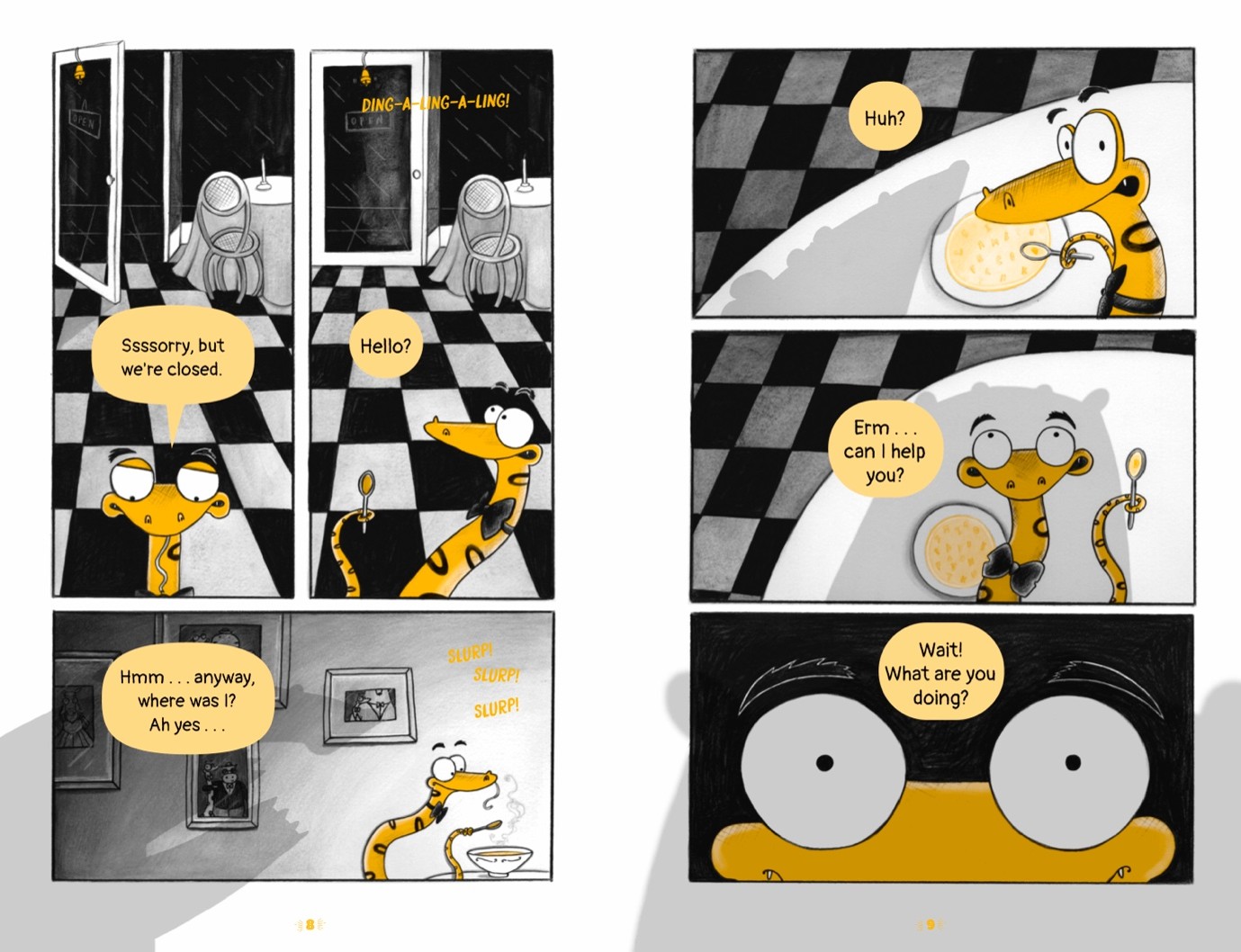
This book is a combo illustrated fiction and graphic novel. Why did that end up being the case?

Film is a huge influence on my work, as is theatre – especially lighting, shadows, and the emotional weight of a well-framed scene. I’ve always admired the mastery of Hitchcock, the slightly unsettling work of Tim Burton, and the storytelling of stop-motion films such as Wes Anderson’s Isle of Dogs and Fantastic Mr Fox. I also love all things Aardman.

So, when I started creating the first Monsieur Mustard story I naturally ran towards including graphic novel sections – which, to me, feel like still frames from a film.

I also have a love of traditional storytelling, so it felt natural to me to combine the two.

There’s a menagerie of animals in your book, what’s your favourite animal to draw and which aspect or feature is the most difficult to capture on an animal (or person)?

My favourite animal to draw is definitely the cat (don’t tell Monsieur Mustard), because there is so much comedy in their personalities to play with, and there is always a slightly evil glint in their eyes.

Speaking of eyes, that is the most difficult feature to capture for me, with both animals and people. They are deceptively tricky because they can tip a character into lifelessness with one wrong move of the pen. As a result, I have gone down many a rabbit hole painting over and re-drawing pupils on the eyeballs of a character until they finally feel right.


What would you say to a young reader who likes to draw but doesn’t feel like they are very good but would like to be?

Oof… I’m afraid that feeling is basically the entry fee of doing anything creative. And I don’t think anyone gets away with not feeling like that. I’m not a big believer in this “you either have talent or you don’t” thing. It’s like when you start playing an instrument — every tune you play sounds like a cat stuck up a tree! But if you love playing that instrument — if you love drawing — you’ll keep going anyway. And with patience, perseverance, and a good amount of stubbornness, that voice that says “Hmm… you’re not very good, are you?” gets quieter and quieter, and eventually, if you let it, it can become something that actually motivates you to get better. Mine is now like a softly spoken, rather lovely old friend.

I will say this as well (although it may sound a little contradictory): don’t listen to other people too much when it comes to your art, because it’s yours. And the thing that’s going to make your art unique and special is that YOU made it, because there’s only one of you. Remember that.


What’s the Best Bit and the Worst Bit about illustrating a story? And what’s one Random Best Bit (which has no positive or negative attached to it, it’s more just an interesting piece of information) about creating this story in particular?

The best bit is that moment when something clicks visually — when a character finally lands on the page and suddenly feels like they have been living there all along. And the worst bit is, well, when they don’t.

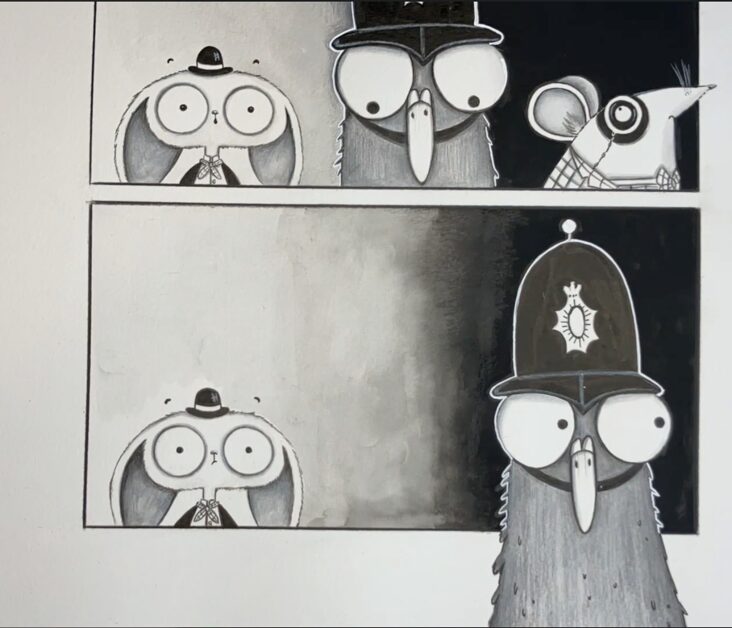
A random “best bit” about creating this story in particular for me was designing the costumes for the characters, because fashion and costume in film especially is a huge interest of mine outside of work. So, for example, I had to design the uniforms for the police pigeon characters, but they couldn’t just have normal skinny sleeves — because they have to fly. So, after quite a lot of sketching, and a frankly suspicious amount of time spent staring at pigeons on the rooftops outside my window, I settled on a kimono-style sleeve. And judging by the aerial acrobatics the pigeon characters pull off in the book, it turns out it was a very practical design choice indeed.

~

Many thanks to Charley for answering our questions. Monsieur Mustard: The Disappearance of Fabio Fangtooth is available now and would suit Lower or Upper Key Stage 2.  You can read more about it using the link below as well as see our savings for schools on library fiction.

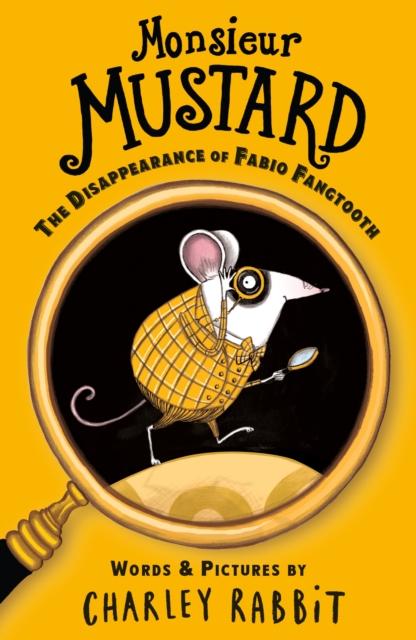
Monsieur Mustard: The Disappearance of Fabio Fangtooth

Charley Rabbit ISBN: 9781839134715

Meet the number one, best dressed, and (possibly) smallest detective in the world, Monsieur Mustard. One evening, way past your bedtime, all was quiet in the city of Bath. Fabio Fangtooth was finishing his alphabet soup. When suddenly . . . Whoomp! . . . he disappeared. Yes, my friends, this is the most SPINE-TINGLING, CLAW-BITING, POOT POOT IN YOUR PANTALOONS mystery that Monsieur Mustard has ever set his little eyes upon. Can our hero crack the case with the villain hot on his tail? Stunningly colour illustrated throughout, with graphic novel pages for the exciting detective scenes! ‘Quirky and fresh! J’adore Monsieur Mustard’ Sheena Dempsey

More Details Add to basket
9781839134715-2.jpg
100 things a

Series Promo: 100 Things to Know About

Awareness FEATURE

Booklists for Schools: Awareness Days

Evoto

Q&A: Sarah Crossan

Top Selling Fiction feature

School Noticeboard: Top Selling Fiction